
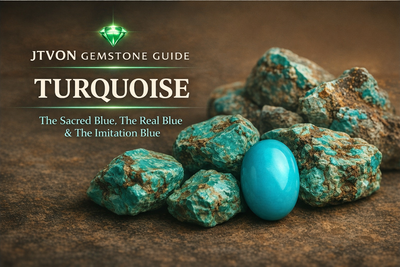
Turquoise: The Sacred Blue, The Real Blue & The Imitation Blue
JTVON on 30th Nov 2025
Turquoise: The Sacred Blue, The Real Blue & The Imitation Blue
Introduction
Turquoise is one of the oldest known gemstones in human history—and one of the most misunderstood.
From ancient civilizations to modern jewelry markets, it has carried cultural significance, artistic legacy, and increasing confusion around authenticity and treatment.
Understanding turquoise means understanding both its history and its reality.
What is Turquoise?
Turquoise is a hydrated copper aluminum phosphate mineral valued for its distinctive blue to green color.
Key Gemological Properties
-
Mineral Family: Phosphate
-
Chemical Composition: CuAl₆(PO₄)₄(OH)₈·4H₂O
-
Mohs Hardness: 5 – 6
-
Crystal System: Triclinic (rarely forms visible crystals)
-
Luster: Waxy to subvitreous
-
Transparency: Opaque
Its color is directly influenced by chemistry:
-
Copper → blue tones
-
Iron → greenish hues
A Gemstone Shaped by Civilization
Long before modern gem markets existed, turquoise was already deeply embedded in human culture.
-
Ancient Egypt: Mined in the Sinai over 5,000 years ago and used in burial masks and amulets
-
Persia (Iran): Revered for its vivid blue and worn as protective talismans
-
Tibet: Considered a stone of cultural and spiritual importance, often passed through generations
-
American Southwest: Integral to Navajo, Zuni, and Hopi jewelry traditions
Turquoise is not simply decorative—it is one of the few gemstones that became a cultural identity marker across multiple civilizations.
Sources and Characteristics
Turquoise varies dramatically depending on origin, each with distinct visual traits:
Sleeping Beauty (Arizona)
-
Bright, uniform robin’s-egg blue
-
Minimal to no matrix
-
Highly sought after since mine closure in 2012
Kingman (Arizona)
-
Rich blue tones with prominent spiderweb matrix
-
Strong contrast and character
Persian (Iran)
-
Historically prized for smooth, even blue
-
Minimal matrix, often considered classic “ideal” turquoise
Tibetan
-
Heavy matrix patterns
-
Earthy, expressive appearance
Chinese
-
Wide range of colors and patterns
-
Major global supplier, often used for stabilized material
Each source reflects unique geological conditions, giving turquoise its wide visual diversity.
Natural vs. Stabilized vs. Imitation Turquoise
This is where clarity matters most.
Natural Turquoise
-
Untreated and unreinforced
-
Often porous and relatively soft
-
Can absorb oils and change color over time
While highly valued by collectors, natural turquoise is not always ideal for daily wear due to its sensitivity.
Stabilized Turquoise
-
Natural turquoise reinforced with a stabilizing agent (typically resin)
-
Improves durability and color consistency
Benefits:
-
Increased hardness and wearability
-
Greater resistance to discoloration
-
More practical for everyday jewelry
Stabilized turquoise remains genuine—it is simply enhanced for longevity.
Imitation Materials
Dyed Howlite or Magnesite
-
Often used to mimic turquoise color
-
Typically brighter, more uniform, and less natural in appearance
Reconstituted (Block) Turquoise
-
Made from crushed turquoise mixed with resin
-
Lacks the structure and value of solid natural material
Understanding these distinctions is essential when evaluating turquoise jewelry.
Gemological Behavior and Care
Turquoise is unique among gemstones due to its porosity and hydration.
-
Can absorb oils, cosmetics, and moisture
-
May darken or shift color over time
-
Sensitive to heat and prolonged sunlight
Care Tips
-
Avoid exposure to chemicals and lotions
-
Store separately to prevent scratching
-
Clean gently with a soft, dry cloth
Its matrix patterns—often mistaken for decoration—are actually remnants of the host rock, providing clues to origin and formation.
Turquoise in Jewelry
Turquoise is most commonly cut as:
-
Cabochons
-
Beads
-
Inlay pieces
It is widely used in:
-
Southwestern jewelry
-
Artisan silverwork
-
Contemporary statement pieces
Its color pairs naturally with:
-
Sterling silver
-
Yellow gold
-
Oxidized or textured metals
Cultural Significance and Craftsmanship
Turquoise’s global recognition owes much to traditional craftsmanship.
Navajo, Zuni, and Hopi artists developed iconic styles such as:
-
Cluster work
-
Needlepoint and petit point
-
Channel inlay
-
Squash blossom necklaces
-
Hand-stamped silver designs
These techniques transformed turquoise into one of the most recognizable gemstone aesthetics worldwide.
Why Transparency Matters in Turquoise
Modern turquoise markets can be confusing due to inconsistent labeling and undisclosed treatments.
A trustworthy approach includes:
-
Clear disclosure of stabilization
-
Accurate identification of materials
-
Avoidance of imitation stones marketed as natural
For most jewelry applications, stabilized turquoise offers the best balance between authenticity and durability.
Conclusion
Turquoise is more than a gemstone—it is a material shaped by geology, culture, and time.
Its enduring appeal comes not just from its color, but from its history, its diversity, and its unmistakable identity.
Understanding the differences between natural, stabilized, and imitation turquoise allows buyers and collectors to make informed, confident choices.
Frequently Asked Questions
Is turquoise a birthstone?
Yes. Turquoise is one of the traditional birthstones for December.
Is natural turquoise better than stabilized?
Natural turquoise is more collectible, but stabilized turquoise is more practical for everyday wear.
Does turquoise change color?
Yes. Due to its porosity, it can darken or shift color over time, especially if untreated.
What is the matrix in turquoise?
Matrix is the host rock within the turquoise, forming natural patterns unique to each stone.
How can you tell if turquoise is real?
Real turquoise typically shows natural variation, matrix patterns, and less uniform color compared to dyed imitations.