
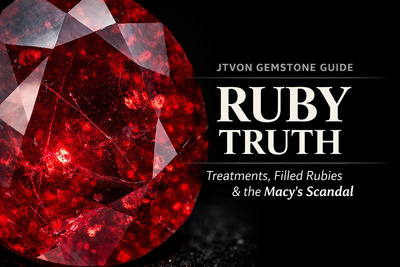
Ruby Truth: Treatments, Fissure-Filled Rubies, and the Macy’s Ruby Scandal
JTVON on 2nd Jul 2025
Ruby Truth (And the Macy’s Scandal)
Here’s something most jewelry sellers won’t say clearly:
Over 90% of rubies on the market today have been treated in some way.
Some treatments are widely accepted within the gemstone industry. Others are far more controversial.
One of the most debated treatments is fissure filling, where leaded glass is introduced into fractures within a ruby to improve clarity and color. This process can transform heavily fractured ruby material into stones that appear transparent, vibrant, and suitable for jewelry.
The treatment itself isn’t the problem.
The problem occurs when these stones are sold as natural ruby without disclosure.
That issue became widely publicized during one of the most notable ruby controversies in modern jewelry retail.
The Macy’s Ruby Controversy
Several years ago, Macy’s faced lawsuits for selling lead-glass filled rubies as natural rubies without proper disclosure.
Lead-glass filled rubies contain natural ruby material, but the fractures within the stone are filled with glass that dramatically improves the stone’s apparent clarity and color.
Because this filling significantly changes both the value and durability of the gemstone, the treatment must be disclosed under FTC jewelry guidelines.
The controversy highlighted a broader issue in the jewelry industry: many consumers simply aren’t told what treatments their gemstones have undergone.
When gemstones are sold without clear disclosure, buyers may believe they are purchasing a natural ruby when in reality they are buying a heavily treated stone.
Transparency matters—especially with gemstones as valuable and historically important as ruby.
Crystal Science: What Makes Ruby Red?
Ruby is not a separate mineral. It is the red variety of corundum.
If corundum occurs in any color other than red, it is classified as sapphire.
The red color in ruby is caused by trace amounts of chromium replacing aluminum within the crystal structure of corundum.
If the chromium concentration is too low, the stone may appear pink rather than red. If concentrations are higher, the stone may show deeper color and strong fluorescence.
When the balance is just right, chromium produces the rich saturated red and glowing internal brilliance that make fine rubies so famous.
Many high-quality rubies also contain rutile silk inclusions. These microscopic needle-like crystals scatter light within the gemstone and create the soft, velvety texture associated with classic Burmese rubies.
Key Gemological Properties of Ruby
Mineral family: Corundum
Chemical composition: Aluminum oxide (Al₂O₃)
Color cause: Chromium
Mohs hardness: 9
Refractive index: ~1.76–1.77
Crystal system: Trigonal
Ruby’s hardness of 9 on the Mohs scale makes it one of the most durable gemstones used in jewelry, second only to diamond among commonly worn gems.
Natural Ruby vs Treated Ruby
Ruby buyers may encounter several different treatment categories in the marketplace.
Untreated Ruby
Natural ruby with no heat treatment. These stones are extremely rare and often command very high prices.
Heat-Treated Ruby
The most common treatment. Heat improves color and clarity by dissolving certain inclusions. This treatment is widely accepted in the gemstone trade when disclosed.
Fissure-Filled Ruby
Rubies with fractures filled with leaded glass to improve transparency and color. These stones are far less valuable and require careful handling.
Each type of ruby occupies a different place in the jewelry market. The critical factor is clear disclosure so buyers understand exactly what they are purchasing.
The Million-Dollar Ruby Market
At the highest end of the gemstone market, ruby sits in a completely different category of value.
Exceptional rubies—especially those from Mogok, Myanmar (Burma)—have sold for over $1 million per carat at auction.
These stones are typically untreated or only minimally heated and display the vivid red color often described in the trade as “pigeon blood” ruby.
One of the most famous examples is the Sunrise Ruby, a Burmese ruby that sold at Sotheby’s for over $30 million, setting a world record price per carat for a ruby.
This extreme value gap is one of the reasons ruby treatments became so widespread. Truly fine rubies are extraordinarily rare, and global demand for ruby jewelry far exceeds the supply of high-quality natural stones.
When a gemstone can sell for over a million dollars per carat, the incentive to enhance lower-grade material becomes enormous.
Durability and Wearability
Natural and heat-treated rubies are among the most durable gemstones used in jewelry and are well suited for rings and everyday wear.
Fissure-filled rubies, however, are significantly more fragile because the glass filling within the fractures is softer and more vulnerable to damage.
These stones can be damaged by:
-
Heat from jewelry repair
-
Ultrasonic or steam cleaning
-
Harsh chemicals
-
Physical impact that exposes filled fractures
Because of this, fissure-filled rubies require more cautious wear and specialized care.
Why Ruby Remains One of the World’s Most Famous Gemstones
Despite the complexities of treatments, ruby remains one of the most desirable gemstones in history.
Important ruby sources include:
-
Mogok, Myanmar (Burma)
-
Mozambique
-
Thailand
-
Sri Lanka
-
Madagascar
Fine rubies with vivid red color and strong fluorescence have captivated collectors, royalty, and jewelry lovers for centuries.
In many cases, truly exceptional rubies can rival or exceed diamonds in price per carat.
The Bottom Line
Ruby is one of the most powerful and historically significant gemstones in jewelry—but it is also one of the most misunderstood.
Treatments are common. Some are accepted, some are controversial, and all of them should be clearly disclosed.
Understanding the differences between untreated ruby, heat-treated ruby, and fissure-filled ruby allows buyers to make informed decisions and appreciate the remarkable science behind this legendary gemstone.
Because in the world of gemstones, knowledge is just as valuable as beauty.
Frequently Asked Questions About Rubies
Are most rubies treated?
Yes. The vast majority of rubies on the market have been treated in some way.
The most common treatment is heat treatment, which improves color and clarity. Heat treatment has been used for centuries and is widely accepted within the gemstone trade when properly disclosed.
More controversial treatments, such as lead-glass fissure filling, are also used to improve the appearance of heavily fractured ruby material.
Because treatments can significantly affect both durability and value, they should always be clearly disclosed to buyers.
What is a fissure-filled ruby?
A fissure-filled ruby is a ruby that has had fractures filled with lead-based glass to improve transparency and color.
During treatment, the ruby is heated and molten glass flows into surface-reaching cracks. Once cooled, the glass filling makes the stone appear clearer and brighter.
These stones still contain natural ruby material, but the glass filling changes both the durability and value of the gemstone.
Because of this, fissure-filled rubies must be clearly disclosed when sold.
Are fissure-filled rubies real rubies?
Fissure-filled rubies do contain natural ruby material, but they are heavily treated gemstones.
The lead-glass filling inside the fractures significantly alters the stone’s structure and durability.
As a result, fissure-filled rubies are generally much less valuable than untreated or heat-treated rubies, and they require more careful wear and cleaning.
Why are some rubies so expensive?
Fine rubies are extremely rare.
High-quality rubies with vivid red color, strong fluorescence, and minimal inclusions are among the rarest gemstones in the world.
Exceptional stones—especially those from Mogok, Myanmar—have sold at auction for over $1 million per carat.
Because the supply of fine ruby is limited while global demand remains high, top-quality stones can reach extraordinary prices.
How can you tell if a ruby is treated?
Determining ruby treatments usually requires examination by a trained gemologist using specialized equipment.
Gemologists may look for features such as:
-
Glass-filled fractures
-
Residue within surface-reaching cracks
-
Heat-altered inclusions
-
Microscopic structures within the crystal
Because many treatments cannot be detected with the naked eye, reputable sellers often provide gemological reports or clear treatment disclosure when selling ruby jewelry.
Are rubies durable enough for everyday jewelry?
Yes—natural and heat-treated rubies are very durable gemstones.
Ruby ranks 9 on the Mohs hardness scale, making it one of the hardest gemstones used in jewelry.
However, fissure-filled rubies are more fragile because the glass filling inside fractures can be damaged by heat, chemicals, or impact.
Proper care and gentle cleaning are important for maintaining these stones.