
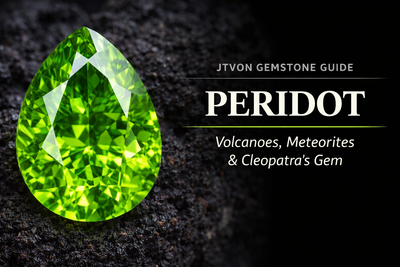
Peridot: Cleopatra’s Green Gem, Born in Volcanoes and Found in Meteorites
JTVON on 6th Aug 2025
Forget the idea that August’s birthstone is just a soft green gemstone sitting quietly in jewelry cases.
Peridot is forged in extreme conditions.
It forms deep in Earth’s mantle, erupts to the surface through violent volcanic activity, and has even been discovered inside meteorites that traveled through space before reaching Earth.
Few gemstones have a story that stretches from the depths of our planet to the asteroid belt.
Born from Outer Space
Peridot is one of the few gemstones that has been identified in meteorites originating beyond Earth.
Gem-quality olivine crystals have been found inside pallasite meteorites, rare space rocks believed to originate from the boundary between the core and mantle of ancient asteroids.
These meteorites likely formed in the asteroid belt between Mars and Jupiter billions of years ago.
While most meteorite peridot crystals are small, some are large enough to cut and polish into gemstones.
That means a peridot gem could represent material that formed before Earth itself fully developed.
Forged Deep in Earth’s Mantle
Most peridot forms much closer to home — but still deep beneath the Earth’s surface.
Peridot originates in Earth’s upper mantle, roughly 20–55 miles below the crust. It reaches the surface when volcanic activity carries mantle material upward.
This volcanic connection explains why peridot is often associated with basaltic lava flows and volcanic regions.
In Hawaii, tiny peridot crystals found in volcanic rock are sometimes called “Pele’s tears,” referencing the Hawaiian goddess of volcanoes.
These crystals occasionally appear in volcanic sand deposits along certain beaches.
Cleopatra’s Legendary Green Gem
For centuries, historians believed Cleopatra’s famous green gemstones were emeralds.
But many gemologists now believe that some of those stones were actually peridot.
Ancient Egypt sourced green gemstones from Zabargad Island in the Red Sea, one of the earliest known peridot mining locations in history.
These mines produced vivid green peridot that was highly prized by Egyptian royalty.
Historical records suggest that the island’s location was carefully guarded, and access to the mines was tightly controlled.
Peridot from Zabargad became one of the earliest documented sources of this remarkable gemstone.
What Is Peridot? (Gemological Properties)
Peridot is the gem-quality variety of the mineral olivine.
Key Gemological Properties
Mineral family: Olivine
Chemical formula: (Mg,Fe)₂SiO₄
Mohs hardness: 6.5–7
Refractive index: approximately 1.65–1.69
Crystal system: Orthorhombic
The gemstone’s green color comes from iron within the crystal structure, which is unusual because many gemstones obtain their color from trace elements.
Peridot ranges from bright lime green to olive green depending on the iron content.
Unlike many gemstones that occur in multiple colors, peridot occurs only in shades of green.
Peridot vs Emerald: Why Ancient Gems Were Often Confused
Before modern gemology, many green gemstones were grouped together under the same name.
This is one reason Cleopatra’s famous green gems were long believed to be emeralds. In reality, some historians and gemologists believe that at least part of her collection may have consisted of peridot from Zabargad Island.
Although the two gemstones appear similar, they are very different minerals.
Peridot
Mineral: Olivine
Hardness: 6.5–7
Color cause: Iron
Color appearance: Lime to olive green
Emerald
Mineral: Beryl
Hardness: 7.5–8
Color cause: Chromium or vanadium
Color appearance: Deeper bluish green
Peridot typically shows a brighter yellow-green glow, while emerald often displays a richer bluish-green tone with visible inclusions.
Today, gemological testing makes distinguishing them straightforward, but in ancient times they were often confused.
Sources of Fine Peridot
Important modern sources include:
Pakistan
Myanmar (Burma)
Arizona, United States
China
Vietnam
Some of the finest crystals come from Pakistan’s high mountain deposits, where miners recover exceptionally clean stones that can exceed 10 carats.
Large, high-quality peridot gems remain relatively uncommon, especially above 10 carats.
Natural by Nature
One of the unusual characteristics of peridot is that it is rarely treated.
Most peridot gemstones on the market are completely natural without heat treatment or clarity enhancements.
This makes peridot somewhat unusual compared with gemstones like ruby, sapphire, emerald, or topaz, which are frequently treated to improve appearance.
In most cases, the color seen in peridot jewelry is exactly how the crystal formed in nature.
Durability and Wearability
Peridot ranks 6.5–7 on the Mohs hardness scale, making it suitable for many types of jewelry.
However, it is softer than gemstones like sapphire, ruby, or diamond.
Because of this, peridot jewelry should be worn with reasonable care, particularly in rings that may experience impact.
With proper care, peridot gemstones can remain beautiful for generations.
Peridot Value and Price Per Carat
Peridot is generally more affordable than many colored gemstones, but high-quality stones can still be valuable.
Several factors influence peridot pricing.
Color
The most valuable stones display a rich saturated green with minimal yellow or brown tones.
Clarity
High-quality peridot is typically eye-clean, meaning inclusions are not visible without magnification.
Size
Large crystals are less common. Stones above 5 carats increase significantly in value, and gems above 10 carats become much rarer.
Fine stones from Pakistan can reach hundreds of dollars per carat, particularly when they combine vivid color, high clarity, and larger sizes.
Collectors often seek these stones because they showcase peridot’s vibrant color particularly well.
Why Peridot Remains Underrated
Despite its fascinating geological story, peridot is often overlooked in the gemstone market.
Because it is widely associated with August birthstone jewelry, many people assume it is inexpensive or common.
In reality, vivid green peridot with high clarity and large size can be surprisingly rare.
Collectors and gemstone enthusiasts often recognize that high-quality peridot represents excellent value compared with many other colored gemstones.
The Bottom Line
Peridot is one of the most geologically fascinating gemstones used in jewelry.
It forms deep in Earth’s mantle, erupts to the surface through volcanic activity, and has even been discovered inside meteorites that formed billions of years ago.
From ancient Egyptian mines to modern mountain deposits, this vivid green gemstone has traveled an extraordinary path to reach the jewelry we wear today.
For a gemstone often labeled simply as an August birthstone, peridot carries a story that spans volcanoes, history, and even outer space.
Frequently Asked Questions About Peridot
Is peridot found in meteorites?
Yes. Peridot crystals have been discovered in rare pallasite meteorites, which likely formed in the asteroid belt billions of years ago. Most peridot gemstones, however, originate within Earth’s mantle.
Is peridot a rare gemstone?
Peridot is not considered extremely rare, but fine-quality stones with vivid color and large size are much less common, particularly above 10 carats.
Is peridot treated?
Peridot is rarely treated compared with many other gemstones. Most peridot sold in jewelry is completely natural without heat treatment or clarity enhancements.
How valuable is peridot?
Peridot prices vary widely depending on color, clarity, and size. High-quality stones can reach hundreds of dollars per carat, especially for large, clean gems with vivid green color.
What gives peridot its green color?
Peridot’s green color comes from iron within the mineral’s crystal structure, which is unusual because many gemstones derive color from trace elements.