
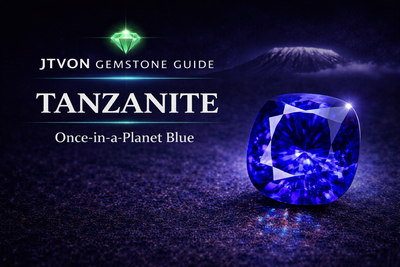
Tanzanite: The Once-in-a-Planet Blue
JTVON on 11th Dec 2025
Introduction
Some gemstones are rare.
Tanzanite is finite.
Discovered in 1967 and found in only one place on Earth, tanzanite isn’t just another blue gemstone—it’s a geological anomaly with a limited lifespan.
Once the deposit is gone, there is no second source. No backup. No substitute.
The Gemstone with an Expiration Date
Tanzanite comes from a single, tightly confined area in the Mererani Hills of Tanzania, near Mount Kilimanjaro.
-
Roughly 2 square miles in size
-
No confirmed deposits anywhere else on Earth
This isn’t rarity in the traditional sense.
It’s geological exclusivity.
Supply continues—for now—but it is not infinite. Every stone mined is part of a resource that does not regenerate.
The Discovery Story—Simplified vs Reality
The commonly repeated version of tanzanite’s discovery is clean and convenient.
The reality is more nuanced.
Blue zoisite had been observed before 1967, but the first official claim is credited to Manuel d’Souza, a prospector who recognized its potential.
What followed was not just a discovery—but a transformation.
Tiffany, Branding, and the Global Rise of Tanzanite
Tanzanite did not become famous by accident.
After its discovery, Tiffany & Co. recognized its potential and introduced it to the global market under a new name. The original mineral name—blue zoisite—was commercially problematic, so the gemstone was rebranded as tanzanite, tying it directly to its geographic origin.
Tiffany’s campaigns positioned it as a rare and luxurious blue gemstone, famously describing it as:
“The most beautiful blue gemstone discovered in 2,000 years.”
The statement was bold, but effective.
They didn’t create the gemstone—but they did shape its public identity. Through strategic marketing and distribution, tanzanite quickly transitioned from a geological discovery to a globally recognized gem.
At the same time, this branding influence introduced a layer of perception: pricing, rarity narratives, and desirability became tied not just to the stone itself, but to how it was presented.
Today, while Tiffany’s role remains historically significant, the finest tanzanite is evaluated not by branding—but by color, cut, and material quality.
Why Tanzanite Exists in Only One Place
The formation of tanzanite required an extremely specific combination of conditions:
-
Vanadium-rich chemistry
-
Regional metamorphism
-
Tectonic pressure
-
Hydrothermal activity
-
A narrow temperature and pressure window
This combination occurred once, in this location.
That is why tanzanite remains geographically isolated—and why it has not been replicated elsewhere in nature.
Color and Optical Properties
Tanzanite is trichroic, meaning it can display different colors depending on viewing direction:
-
Blue
-
Violet
-
Reddish or burgundy tones
When properly cut, these directions combine into the vivid blue-violet color the gemstone is known for.
Heat Treatment: Standard, Not Controversial
Nearly all tanzanite is heat-treated.
Natural rough often contains brownish or yellowish tones. Controlled heating removes these, revealing the saturated blue-violet color associated with fine material.
Key points:
-
The treatment is permanent and stable
-
It is fully accepted in the trade
-
The gemstone remains natural and mined
This places tanzanite alongside many other routinely heat-treated gemstones.
Grading, Marketing, and Misconceptions
There is no standardized grading system for tanzanite.
Terms such as:
-
AAA
-
“Royal Blue”
-
“Exceptional”
are marketing descriptors, not formal gemological grades.
What actually determines quality:
-
Color saturation (most important)
-
Tone
-
Clarity
-
Cut
A deeply saturated, well-cut stone will consistently outperform lighter material—regardless of labeling.
Mining Reality: Beauty and Risk
Tanzanite’s rarity comes with difficult mining conditions.
-
Depths can exceed 300 meters (nearly 1,000 feet)
-
Narrow shafts with limited infrastructure
-
Elevated temperatures and reduced airflow
Historically, smuggling was a major issue, with significant amounts of material leaving the country unofficially.
In 2018, Tanzania constructed a 24-kilometer perimeter wall around the mining region and increased regulation. This significantly reduced illegal export and increased national revenue.
Durability and Wearability
Tanzanite has a hardness of 6 to 6.5, making it suitable for jewelry with proper care.
-
Ideal for earrings and pendants
-
Suitable for rings when set protectively
It is not unusually fragile—it simply requires the same consideration given to many fine gemstones.
Jewelry Use
Tanzanite is commonly used in:
-
Rings
-
Earrings
-
Pendants
It pairs well with:
-
White gold and platinum for contrast
-
Yellow gold for warmth
Its color and rarity make it a strong centerpiece stone.
Why Tanzanite Stands Apart
Tanzanite occupies a unique position in the gemstone world:
-
Single-source origin
-
Limited and finite supply
-
Distinctive blue-violet color
-
Rapid rise in global demand
Few gemstones combine geological rarity, modern discovery, and market impact in the same way.
Conclusion
Tanzanite is not just rare—it is singular.
A gemstone formed once, in one place, under conditions that may never occur again.
Its supply is finite.
Its origin is fixed.
Its identity is unmistakable.
Frequently Asked Questions
Is tanzanite rare?
Yes. It is found in only one location and has a limited supply.
Is tanzanite treated?
Yes. Nearly all tanzanite is heat-treated, which is standard and permanent.
Is tanzanite durable?
It is suitable for jewelry with proper care and protective settings.
Is tanzanite a birthstone?
Yes. It is one of the birthstones for December.