
Fire Opal: Mexico’s Volcanic Gemstone and the Science Behind Its Living Flame
JTVON on 26th Oct 2025
Fire Opal: The Volcanic Flame of the Opal World
When most people think of opal, they imagine stones filled with shifting rainbow flashes.
Fire opal is different.
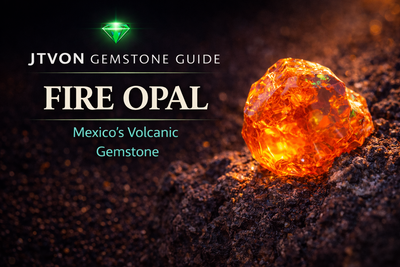
Instead of relying on play-of-color, fire opal captivates with its intense body color—glowing shades of yellow, orange, and deep red that appear almost lit from within.
These vibrant gemstones form in volcanic environments, making fire opal one of the most distinctive members of the opal family.
Forged in Volcanic Landscapes
While many opals form in sedimentary environments, fire opal is commonly associated with volcanic rock formations.
In regions of central Mexico, especially Querétaro and Jalisco, silica-rich fluids once filled cavities within ancient volcanic flows. Over time, this silica solidified into opal, capturing warm tones that reflect the surrounding volcanic geology.
The result is a gemstone that often appears transparent to translucent, glowing with fiery orange or golden hues.
Unlike many other opals, fire opal is frequently faceted rather than cut into cabochons because of its clarity.
Color: The Flame Within
The defining characteristic of fire opal is its body color.
Typical colors include:
-
bright yellow
-
golden amber
-
vivid orange
-
deep reddish orange
These colors come from trace elements such as iron within the silica structure.
Some fire opals also display play-of-color, the rainbow flashes associated with precious opal. When both features occur together—vivid orange body color and strong spectral flashes—the stones become especially rare and valuable.
Fire Opal in Ancient Cultures
Long before modern gemology described fire opal scientifically, ancient Mesoamerican civilizations valued the stone for its vivid color.
Historical records suggest that Aztec cultures referred to opal using the Nahuatl term “quetzalitzlipyollitli,” which has been interpreted as a poetic reference to the brilliance of the gemstone.
To these civilizations, fire opal symbolized energy, vitality, and the natural power of the Earth.
Mexico’s National Gemstone
Fire opal is often associated with Mexico, where many of the world’s finest examples are mined.
The most famous deposits are located in:
-
Querétaro
-
Jalisco
-
Hidalgo
Mexican fire opals gained international recognition during the 19th and 20th centuries and remain among the most distinctive gemstones produced by the region.
Today, fire opal is widely considered Mexico’s national gemstone.
Fire Opal vs Precious Opal
One common misconception is that all opals display play-of-color.
In reality, opals are generally divided into two broad groups:
Precious Opal
Displays the rainbow flashes known as play-of-color.
Common Opal
Lacks play-of-color and instead displays body color.
Fire opal can belong to either category. Some stones display only their vivid orange body color, while others show both body color and play-of-color.
Gemological Properties of Fire Opal
Mineral type: Hydrated silica (opal)
Chemical composition: SiO₂·nH₂O
Mohs hardness: approximately 5.5–6.5
Structure: Amorphous mineraloid
Typical transparency: transparent to translucent
Like other opals, fire opal contains water within its structure, which contributes to its unique appearance.
Durability and Care
Fire opal is somewhat softer than many gemstones used in jewelry.
Because of this, it should be protected from:
-
strong impacts
-
sudden temperature changes
-
prolonged dryness
Cleaning is best done using mild soap and lukewarm water, avoiding ultrasonic or steam cleaners.
With proper care, fire opal jewelry can remain beautiful for many years.
Why Fire Opal Stands Apart
Fire opal offers something unique among gemstones.
Rather than relying solely on brilliance or sparkle, it captivates through pure color and transparency—a warm glow reminiscent of molten lava or sunset light.
Its volcanic origins, cultural history, and vibrant appearance make it one of the most distinctive members of the opal family.
Frequently Asked Questions About Fire Opal
What makes fire opal different from other opals?
Fire opal is known for its vivid orange, yellow, or red body color. Some stones may also display play-of-color, but many do not.
Where are fire opals found?
The most famous deposits are located in Mexico, particularly in Querétaro and Jalisco.
Are fire opals valuable?
High-quality fire opals with strong color and good transparency can be highly valued, especially if they also display play-of-color.
Are fire opals durable for jewelry?
Fire opal has a hardness of about 5.5–6.5, so it should be worn with care and protected from impacts.
Do fire opals always show rainbow flashes?
No. Many fire opals display only their orange body color, while others may show play-of-color.