
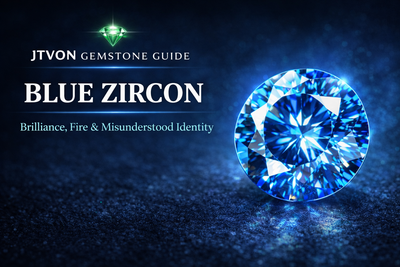
Blue Zircon: The Brilliant Blue Gemstone Everyone Confuses
JTVON on 2nd Dec 2025
Blue Zircon: The Brilliant Blue Gemstone Everyone Confuses
Introduction
December has multiple birthstones—but only one delivers exceptional brilliance with unmistakable intensity.
Blue zircon is one of the most misunderstood gemstones in the jewelry world. Often confused with cubic zirconia, it is in fact a natural, mined gemstone with a long history and some of the most impressive optical properties of any colored stone.
Once seen in person, it’s rarely forgotten.
What is Blue Zircon?
Zircon is a natural mineral composed of zirconium silicate, prized for its brilliance and optical performance.
Key Gemological Properties
-
Mineral Family: Nesosilicate
-
Chemical Composition: ZrSiO₄
-
Mohs Hardness: 7 – 7.5
-
Refractive Index: ~1.92 – 1.98
-
Crystal System: Tetragonal
-
Optical Character: Doubly refractive (birefringent)
-
Dispersion: High
Its high refractive index and dispersion give zircon exceptional sparkle—often rivaling or exceeding many other colored gemstones.
Optical Performance: Why Blue Zircon Stands Out
Blue zircon’s brilliance is driven by three key optical features:
High Refractive Index
Zircon has one of the highest refractive indices among colored gemstones, allowing it to reflect large amounts of light back to the viewer.
Birefringence (Double Refraction)
Light entering zircon splits into two rays, creating a subtle doubling of facet edges under magnification. This contributes to its distinctive, almost “liquid” brilliance.
Strong Dispersion
Zircon disperses light into spectral colors, producing visible flashes of fire similar to diamond.
The result is a gemstone with a lively, dynamic appearance that stands out even in low lighting.
Color and Treatment
Most blue zircon on the market is heat-treated, which is standard and fully accepted in the trade.
Why Heat Treatment is Used
Natural zircon often forms in:
-
Brown
-
Yellow
-
Reddish tones
Controlled heating alters the crystal structure, producing the vivid blue colors seen in jewelry.
Important Notes
-
The treatment is permanent and stable
-
It is widely disclosed and industry standard
-
The gemstone remains natural and earth-mined
This places zircon alongside many other commonly heat-treated gemstones such as aquamarine and tanzanite.
Zircon vs. Cubic Zirconia
This is one of the most important distinctions in gemology.
Zircon
-
Natural mineral
-
Mined from the Earth
-
Birefringent
-
High brilliance and fire
-
Used in jewelry for centuries
Cubic Zirconia (CZ)
-
Synthetic material
-
Manufactured as a diamond simulant
-
Single refractive
-
Lower optical complexity
-
Not related to zircon
Despite the similarity in name, the two are completely unrelated in composition, structure, and origin.
Sources
Blue zircon is found in several key locations:
-
Cambodia (Ratanakiri): Known for vivid, saturated electric blues
-
Sri Lanka: Produces lighter, more refined blue tones
-
Tanzania: Less common, often highly collectible
-
Myanmar & Vietnam: Smaller-scale sources with varied material
Each locality produces slightly different color characteristics, contributing to zircon’s diversity.
Durability and Wearability
With a hardness of 7 to 7.5, zircon is suitable for most types of jewelry.
-
Ideal for earrings and pendants
-
Suitable for rings with proper setting protection
While zircon has some brittleness due to its structure, it performs well in jewelry when handled with normal care.
Blue Zircon vs. Other Blue Gemstones
Blue Zircon
-
High brilliance and fire
-
Vibrant, electric tones
-
Visually dynamic
Aquamarine
-
Softer, pastel blue
-
Lower dispersion
-
More subtle appearance
Blue Topaz
-
Consistent, often treated color
-
Affordable and widely available
-
Lower brilliance compared to zircon
Blue zircon stands apart for its combination of intensity, brilliance, and optical complexity.
Jewelry Use
Blue zircon is commonly cut in:
-
Round brilliant cuts
-
Oval and cushion shapes
-
Antique-style cuts that emphasize dispersion
It pairs well with:
-
White gold and platinum for contrast
-
Yellow gold for warmth
Due to its brilliance, it is often used as a center stone in statement pieces.
Interesting Facts
-
Zircon is one of the oldest minerals on Earth, with some crystals dating over 4 billion years
-
It has been used in jewelry for thousands of years
-
The name “zircon” likely comes from the Persian word zargun, meaning “gold-colored”
Frequently Asked Questions
Is blue zircon natural?
Yes. Blue zircon is a natural gemstone that is typically heat-treated to enhance its color.
Is zircon the same as cubic zirconia?
No. Zircon is a natural mineral, while cubic zirconia is a synthetic material with no relation to zircon.
Is blue zircon durable?
Yes. With proper care, it is suitable for most jewelry types.
Does blue zircon sparkle more than other gemstones?
It has exceptionally high brilliance and dispersion, making it one of the most visually dynamic colored gemstones.