
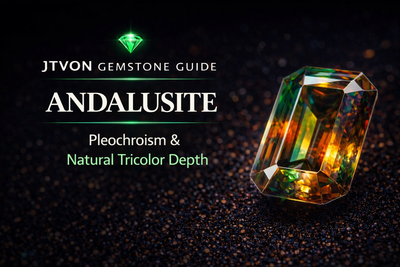
Andalusite: Pleochroism, Hidden Crosses & the Science Behind Its Tricolor Glow
JTVON on 4th Nov 2025
Andalusite: The Tricolor Underdog of Gemology
Some gemstones demand attention. Andalusite doesn’t need to — it simply changes color and lets the light do the talking.
Often overlooked outside gemological circles, andalusite is one of the most fascinating optical gemstones on Earth. With its natural ability to display multiple colors from different angles, it offers a level of visual complexity that few stones can match.
This is the quiet standout — the gem professionals notice immediately.
A Natural Masterclass in Pleochroism
Andalusite belongs to the orthorhombic crystal system, giving it a unique internal structure that interacts with light in three different directions.
The result is strong pleochroism — one of the defining features of this gemstone.
Depending on how the stone is viewed, you may see shifting tones of:
• olive green
• golden yellow
• coppery orange
• reddish brown
Unlike surface effects or color-change gems, this is not an artificial trick or a coating. It is built into the crystal itself.
When properly cut, these colors blend into a rich, natural tricolor effect that feels dynamic and alive.
Precision Matters: A Cutter’s Stone
Andalusite is notoriously unforgiving during cutting.
Because of its directional color properties, even a slight misalignment can result in a dull or muddy appearance. When oriented correctly, however, the stone reveals its full spectrum — a balance of green, gold, and warm earth tones.
This makes fine andalusite a true collaboration between geology and lapidary precision.
A Family of Polymorphs
Andalusite shares its chemical composition with kyanite and sillimanite. These three minerals are known as polymorphs — identical chemistry, but different crystal structures formed under varying conditions of heat and pressure.
Each represents a different geological environment, with andalusite forming under conditions that favor stability and clarity.
It is not just a gemstone — it is a record of how the Earth builds minerals under pressure.
Origins and Sources
High-quality andalusite is relatively rare and sourced from only a few important regions:
• Brazil (Minas Gerais) – known for vibrant tricolor “sunset” material
• Sri Lanka – produces lighter, often olive-dominant stones
• Spain – the original locality and source of collector specimens
• Madagascar – known for larger crystals and deeper tones
Because crystals are often small and difficult to orient, well-cut stones with strong color contrast are uncommon.
Chiastolite: The Cross Within
A rare variety of andalusite, chiastolite, contains natural carbon or graphite-rich inclusions that form a distinct cross pattern inside the crystal.
When cut and polished, this structure becomes clearly visible — a naturally occurring geometric feature that has fascinated collectors for centuries.
Historically, chiastolite was worn as a protective talisman, particularly in medieval Europe. Today, it remains one of the most recognizable and unusual mineral varieties.
Why Collectors Pay Attention
Andalusite occupies a unique place in the gemstone world:
• typically untreated
• durable enough for regular wear at about 7.5 on the Mohs scale
• difficult to imitate because of its complex optics
• each stone displays unique color zoning
It is not a mass-market gemstone — and that is part of the appeal.
For collectors and buyers seeking something less conventional, andalusite offers authenticity without overexposure.
Style and Wearability
Andalusite’s earthy palette makes it especially versatile in jewelry design.
It pairs naturally with:
• yellow gold for warmth
• rose gold for richness
• darker or brushed finishes for contrast
Rather than dominating a piece, it adapts to light and movement, subtly shifting in tone throughout the day.
It is a gemstone that rewards attention — the more you look, the more you see.
The Real Fire of Fall
Andalusite does not rely on brilliance or saturated color to stand out.
Its beauty is slower, deeper, and more complex.
In a market filled with uniform color and lab-grown perfection, it offers something different — natural variation, optical depth, and geological authenticity.
It does not shout.
It does not compete.
It simply reveals itself.
Frequently Asked Questions About Andalusite
What is andalusite?
Andalusite is a naturally occurring aluminum silicate mineral known for strong pleochroism, meaning it can show different colors from different viewing directions.
What colors does andalusite show?
Andalusite commonly shows olive green, gold, copper, brown, and reddish tones, often blending into a tricolor appearance when well cut.
Is andalusite rare?
Fine gem-quality andalusite is relatively uncommon, especially stones with strong pleochroism and attractive cutting.
What is chiastolite?
Chiastolite is a variety of andalusite that shows a natural cross pattern caused by dark inclusions inside the crystal.
Is andalusite good for jewelry?
Yes. With a Mohs hardness around 7.5, andalusite is suitable for many jewelry types, especially earrings, pendants, and carefully worn rings.