
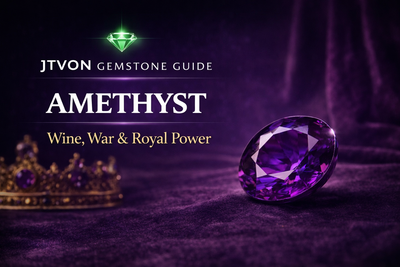
Amethyst: Wine, War, and the Color of Kings
JTVON on 25th Jan 2026
Introduction
Purple was not always just a color.
For much of human history, it was controlled, restricted, and reserved for authority. To wear purple signaled status. To control it meant power.
Amethyst became the gemstone expression of that power—worn not for decoration, but for presence.
Long before it became a birthstone or a modern retail staple, amethyst was associated with discipline, clarity, and control in environments where losing either could be costly.
What Amethyst Is
Amethyst is the purple variety of quartz, colored by trace amounts of iron and natural irradiation.
-
Mineral Family: Quartz
-
Chemical Composition: SiO₂
-
Crystal System: Trigonal
-
Mohs Hardness: 7
-
Refractive Index: ~1.54–1.55
It forms in geodes, veins, and hydrothermal deposits, often in large crystal clusters.
Purple and Power in the Ancient World
In ancient Rome, purple dye—particularly Tyrian purple—was tightly controlled.
-
Reserved for emperors and elite classes
-
Illegal for unauthorized use
-
Associated directly with authority and governance
Amethyst did not replace purple textiles—it reinforced them.
It appeared in:
-
Signet rings
-
Crowns
-
Religious regalia
-
Official adornment
It provided a permanent, durable expression of the same visual authority.
Wine, Intoxication, and the Meaning of Amethyst
The name amethyst comes from the Greek amethystos, meaning “not intoxicated.”
This was not simply symbolic—it reflected a cultural concern.
In societies where leadership was tied to discipline, maintaining control mattered. Amethyst was believed to help prevent intoxication and preserve clarity of thought.
It was used in:
-
Drinking vessels
-
Rings
-
Personal adornment
Whether literal or psychological, the association reflects how strongly the stone was tied to restraint and awareness.
Historical Use: Authority, Not Ornament
Amethyst appears throughout history in contexts tied to power:
-
Roman and Byzantine jewelry
-
Ecclesiastical rings worn by bishops
-
Medieval signet rings used for official seals
-
Ceremonial regalia
It was not positioned as a passive gemstone.
It was associated with decision-making, authority, and visibility.
Formation and Sources
Amethyst forms in a variety of geological environments, most commonly in volcanic rock cavities.
Major Sources
-
Brazil – large-scale production, wide color range
-
Uruguay – deeper, more saturated material
-
Zambia – often rich, slightly bluish-purple tones
-
Russia (historical) – source of highly prized “Siberian” material
The Supply Shift That Changed Its Reputation
For centuries, amethyst was considered among the most valuable gemstones.
That changed with the discovery of large deposits in Brazil and South America.
-
Supply increased dramatically
-
Market prices dropped
-
Accessibility increased
This was not a decline in quality—it was a shift in availability.
Amethyst transitioned from rare to widely available, altering its position in the market.
Color Range and Quality Factors
Amethyst is not a single uniform color.
Color Variations
-
Pale lavender
-
Rose de France
-
Medium purple
-
Deep royal violet
-
Reddish-purple
-
Bluish-purple
Quality Factors
-
Color saturation (most important)
-
Even distribution of color
-
Minimal zoning
-
Performance in low light
High-quality amethyst maintains depth and vibrancy outside of strong lighting conditions.
“Siberian” Amethyst and the Benchmark Standard
Historically, the finest amethyst came from Russia.
“Siberian” amethyst became known for:
-
Rich, saturated purple
-
Subtle red and blue flashes
-
Strong performance in varied lighting
While true Russian material is rare today, the term remains a benchmark for top color quality.
Treatments and the Citrine Connection
Amethyst is often heat-treated.
What Happens During Heating
-
Purple color shifts to yellow or orange
-
Material becomes citrine
This is a natural chemical response involving iron within the crystal structure.
Important Notes
-
Heat treatment is common and stable
-
Amethyst and citrine are both quartz
-
Some citrine on the market originates from heated amethyst
Understanding this relationship helps distinguish natural formation from treatment.
Durability and Wearability
-
Mohs Hardness: 7
-
Toughness: Good
-
Cleavage: None
Amethyst is suitable for:
-
Rings
-
Earrings
-
Pendants
It performs well in everyday jewelry when properly set.
Jewelry Use
Amethyst works across a wide range of styles.
It pairs especially well with:
-
Yellow gold (enhances warmth)
-
White gold and silver (contrast)
-
Mixed-metal designs
Its availability allows for both large statement pieces and refined designs.
Why Amethyst Is Misunderstood
Amethyst’s reputation shifted due to availability—not quality.
-
Large deposits reduced perceived rarity
-
Lower-grade material became widespread
-
Marketing repositioned it as a “soft” or “calming” stone
This simplified narrative overlooks its historical role and gemological value.
Conclusion
Amethyst has been a gemstone of authority, discipline, and visibility across centuries.
Its widespread availability today has changed perception—but not its nature.
It remains:
-
Structurally sound
-
Visually impactful
-
Historically significant
Understanding amethyst requires looking beyond modern marketing and recognizing the depth of its past.
Frequently Asked Questions
Is amethyst rare?
High-quality material is less common than lower-grade commercial stones.
Is amethyst treated?
Some amethyst is heat-treated, especially when converted to citrine.
Is amethyst durable?
Yes. With a hardness of 7, it is suitable for most jewelry types.
What color is best for amethyst?
Deep, saturated purple with balanced red and blue tones is considered most desirable.